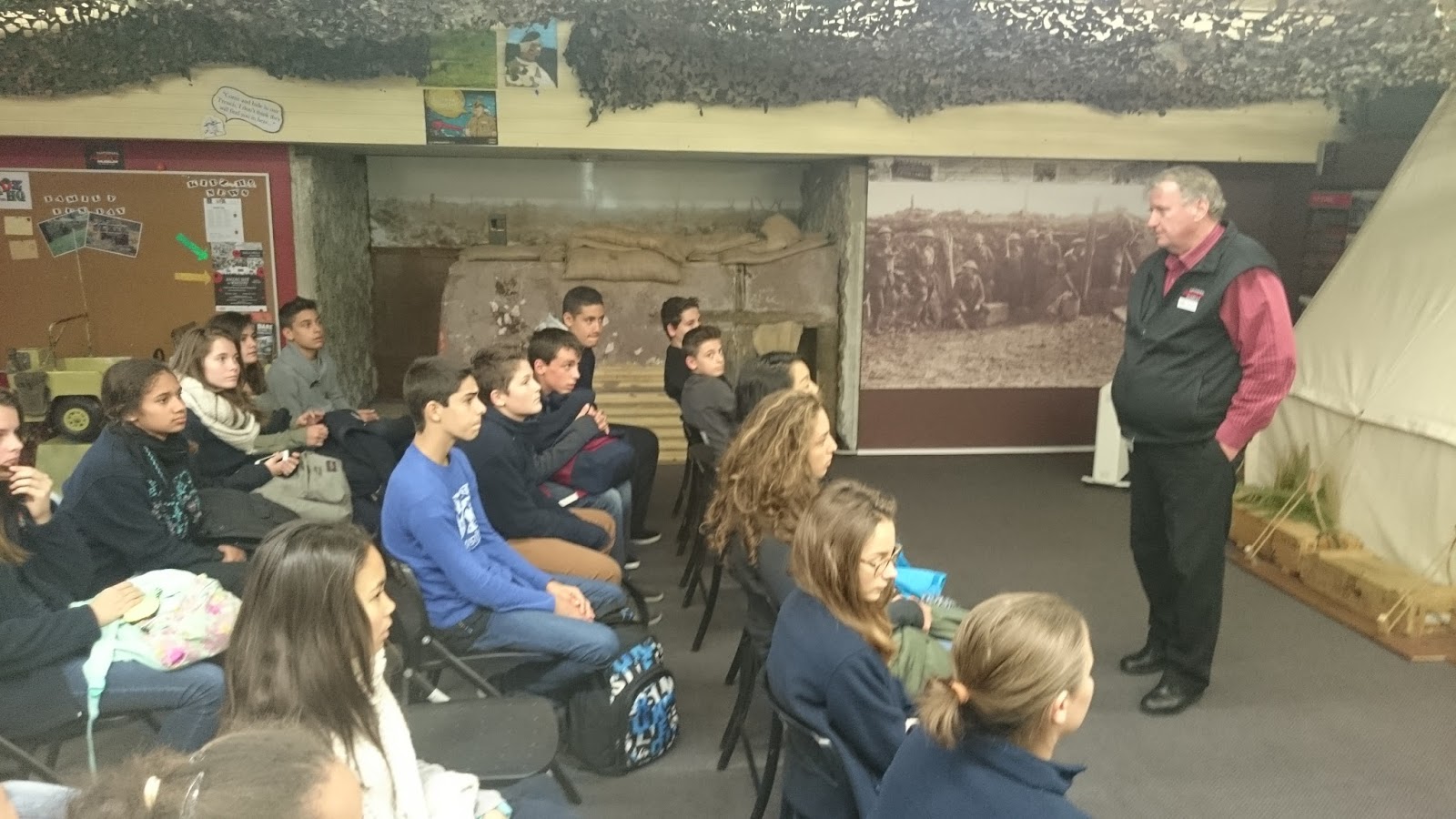
Nos travaux sur la mémoire de la Première guerre mondiale ont été exposés au musée de la ville de Nouméa le 4/11 ; à cette occasion nous avons chanté "and the band played waltzing Mathilda" avec les élèves de la classe défense.
Les professeurs étaient nombreux pour venir nous soutenir !
Aujourd'hui, M. David (correspondant du souvenir français en Nouvelle-Calédonie) est venu au collège tenir une conférence sur la Première Guerre mondiale.
Il a d'abord présenté un diaporama sur les animaux dans la Grande Guerre, leur utilisation dans les conditions de combat et nous a livré des anecdotes amusantes sur certains d'entre eux.
Il a terminé sa présentation en nous expliquant en quoi consistait son action et en rappelant l'importance du souvenir de ce conflit, et nous a renvoyé à notre devoir de mémoire.
When he died, a young man was eaten by rats in the trenches. Four hours after, only a few parts of his body remained.
This fact showed the horror in the trenches, with the lack of hygiene, the fright of the fights, the lack of sleep, and... rats.
Rats ate everything: food, corpses... They invaded the trenches !
The Poppies wall was the most interesting thing in the museum for me, because it was really impressive and there Thousands of Poppies symbolizing all the deads during the war : red for soldiers, white for horses and green for the dogs. It was really affecting because it was so beautiful... Its really sad. 🌸
When we went to the Waiouru museum, I liked the poppy wall because there was a lot of flowers and each of them represents a dead. When I saw that I thought about all the families who lost a husband, a father or a son...
The item that moved me was the "box of smells". This box contains the smells one could smell during the first world war. I ,then realized that the soldiers lived in terrible conditions. The smells were horrible and the soldiers couldn't avoid it.
Wednesday 29 July, we went to the National Army Museum.
The travel was boring because it was very long. We saw every type of weather: snow,rain,sun,cloudy sky and hail.
When we arrived it was very cold and in the museum we saw a café: SWEET! But we had to visit the museum... too bad! 😔😔 so the guide Mark was waiting for us,he explained us the visit of the museum. Then we started. He explained us the life of soldiers in the trenches, and many aspects of the war.
After the visit we went to a hangar.We were divided in 5 groups and a member of the staff gave us soldiers' rations. We had to cook it and share it.
On the menu, we had beef and chicken stew with noodles. It was fun to live like a soldier but just for an hour...
Pour notre première sortie, nous sommes allés nous plonger dans le passé de la Nouvelle Zélande: les collections de ce musée sont des mines pour notre projet historique et les expériences que nous avons vécues nous ont souvent touché
Nous avons mangé des rations de combat réchauffées dans des gamelles avant de rentrer sous la neige à Taupo.
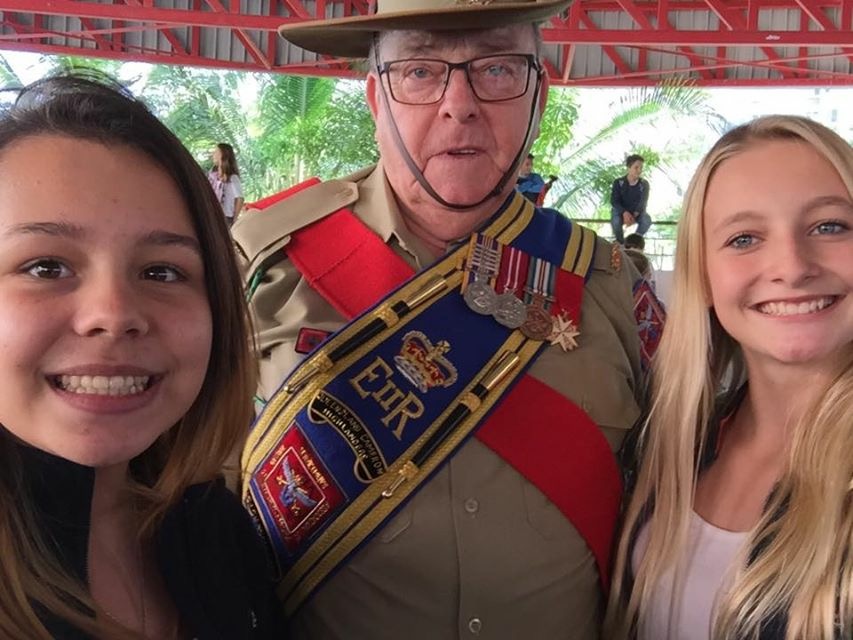
Last friday, Australian ex-soldiers " The Australian bagpipers" came to our highschool, in the playground, and they played hornpipes. At the end, they played our national anthem so to thank them, we sang " The band played waltzing mathilda", our song to remind the battle of Gallipoli. After that, we took pictures and talked with them. Here you have pictures and a video :
Le vendredi 24 avril 2015, le jour du centenaire de l'anzac, nous nous sommes rendus au commémorial de Bourail pour accomplir notre devoir de mémoire envers les soldats néo-zelandais.
A 5h45 du matin, nous nous sommes retrouvés devant le collège afin de partir en bus pour Bourail. Après deux heures et demi de route, nous sommes arrivés au cimetière néo-zélandais.Beaucoup d'autorités étaient présentes (De Nouvelle-Calédonie, de Nouvelle-Zélande et d'Australie) ainsi que plusieurs soldats et d'autres classes de collège et d'école primaire. Après avoir entendus les différents hommages aux combattants décédés, chaque personnes a fleuri une tombe. Toutes les tombes ont eu leurs fleurs. Nous avons été touchés par l'âge de certains combattants, parfois morts à 18 ans! Nous nous sommes recueillis pendant que les Autorités partaient, plongés dans leurs pensées. Nous avons ensuite chanté une chanson sur le mémorial, devant les tombes. Nous avons mangé sur place, puis nous sommes repartis au collège.
Nous remercions particulièrement l'Administration du collège, Mr Mathieu, l'équipe de la restauration scolaire, l'APCM, le gardien du cimetière et nos chers professeurs.
The Gallipoli campaign took place during the first World War. That was a terrible war! Life wasn't cool and happy. The soldiers had few things to eat. They had to eat canned food and the battle lasted a long time (8 months!).
This battle opposed the Turkish troops to the ANZAC troops.This battle took place principally in the trenches.The troops fought to shoot on the enemy's trenches.
This battle caused 250 000 casualties (this is lot of dead people!!!) and lasted from April 25th 1915 to January 9th 1916 (i don't know how they did! it's very hard to fight many many days).
We had a lesson in English and learnt the song "And The Band Played Waltzing Matilda" by Eric bogle in order to study the battle of Gallipoli.
I was very sad when I heard it, I wanted to cry. It's a very good song.
Des lycéens de la classe de 1e du lycée français "Pierre Loti" d'Istambul se sont pliés au même exercice que nos élèves en répondant au questionnaire et en partageant avec nous ce que signifie pour eux la mémoire de la Première Guerre mondiale, en Turquie ou dans d'autres pays... Ces élèves participent eux aussi à des projets de commémoration du conflit dans le cadre de leurs cours.
Une contribution de plus à notre panorama des mémoires de la Grande Guerre, que nous pourrons comparer avec les travaux de nos élèves !
Un grand "Tesekkür ederim !" à ces élèves et à leur professeur que nous tiendrons au courant des suites de notre projet...
Et c'est une élève d'Allemagne qui s'est prêtée au jeu ! Grâce à Mieke, nous avons déjà des informations sur la manière dont on célèbre la mémoire des soldats dans la région de Brême.
To prepare the visit on Friday,April 24th 2015 at the cemetery of Bourail for ANZAC Day, we worked on a song called "And The Band Played Waltzing Mathilda" by Eric Bogle.We gathered so many times around Mrs Dedieu, our music teacher, to rehearse the song for the D day.
To pay a tribute to the soldiers, we also worked on the Poppy Story. We watched a video that explained why on November 11th,in the United Kingdom and on April 25th in Australia and New Zealand, people wear a poppy as a brooch.
After the video , our teachers proposed us to make our own brooch that we could wear on Friday 24th.
We decided to mix a poppy and a corn flower because we are French and, the corn flower is the emblem of the French soldiers.
Extract from "The Band Played Waltzing Matilda" by Eric Bogle
Now when I was a young man, I carried me pack, and I lived the free life of the rover From the Murray Green Basin to the dusty Outback, well, I waltzed my Matilda all over.
Then in 1915, my country said Son, it's time you stopped rambling, there's work to be done. So they gave me a tin hat, and they gave me a gun, and they marched me away to the war.
And the band played Waltzing Matilda, as the ship pulled away from the quay And amidst all the cheers, the flag-waving and tears, we sailed off for Gallipoli
And how well I remember that terrible day, how our blood stained the sand and the water And of how in that hell that they called Suvla Bay, we were butchered like lambs at the slaughter.
Johnny Turk he was waiting, he'd primed himself well. He shorwer'd us with bullets, and he rained us with shell. And in five minutes flat, he'd blown us all to hell Nearly blew us right back to Australia.
 Nos travaux sur la mémoire de la Première guerre mondiale ont été exposés au musée de la ville de Nouméa le 4/11 ; à cette occasion nous avons chanté "and the band played waltzing Mathilda" avec les élèves de la classe défense.